ASTARIJA AJ-131 PLUS - Professional massage chair
With revolutionary massage rollers and advanced functions, including innovative voice control, the Astarija AJ-131 PLUS professional massage chair cr..
ASTARIJA MEGATRON - Professional massage chair
Astarija Megatron - Professional 6D massage chair that offers complete relaxation in the comfort of your home. This professional 6D massage chair is des..
ASTARIJA AJ-800 PLUS - Professional massage chair
Pamper yourself with the updated model from the Astari family - AJ-800 Professional massage chair. With its innovative 3D massage mechanism, adjustab..
Regular massages are a great way to easily improve your health and mood. Therefore, in this article, we present to you 7 reasons why it is recommended to relax at home in a massage chair.After reading this article, you will find that massage chairs a..
A long and tiring day at work means sore muscles and a stiff neck for many people. Visiting the nearest masseur can be time-consuming and, above all, expensive. Instead, consider investing in a massage chair that will save you time and money in the l..
XSTO ZW4250 - Electric Stair Climber
THE BEST WAY TO OPTIMIZE WORK
XSTO ZW4250 - Transport trolley for stairs with pneumatic wheels can be used for cargo up stairs up to 250 kg..
XSTO ZW7200GC - Stair Climbing Trolley
UP TO 200 KG EFFORTLESSLY TO THE HIGHEST FLOOR!
The aluminum frame and premium components make the stair climbing trolley ZW700GC lightweight..
XSTO CT105C - Electric stair climber
LIGHTWEIGHT, POWERFUL, FOLDABLE
Looking for a portable and durable stair climbing transport trolley? XXSTO CT105C is the ideal solution! This l..
XSTO TR250T - Stair climber for wheelchair
ELECTRIC CATERPILLAR FOR TRANSPORTATION OF PEOPLE WITH LIMITED MOBILITY UP THE STAIRS
XSTO TR250T - The stair climber for the disabl..
XSTO M4 - Power mobility chair
BEST POWER MOBILITY CHAIR
XSTO M4 - Power mobility wheelchair that will improve and facilitate many journeys: Adjustable seat height, mecanum whe..
XSTO TR140C -Stair climbing wheelchair
ELECTRIC STAIRWHEEL FOR PEOPLE WITH REDUCED MOBILITY
XSTO TR140C - The stair wheelchair boasts a space-saving compact design and is suitable f..
In today's fast pace of life, innovative solutions are always being sought to facilitate everyday tasks. One of the obstacles we encounter when transporting loads to higher or lower floors are definitely stairs. These are often the only way to tra..
JJ POWER FL-E350F - Electric pallet stackerPowerful and safe for workSimple operation with the handleThey speed up the work processAffordable and environmentally friendlyPowerful and safe for workJJ P..
JJ POWER FL-E350A - Electric pallet stackerPowerful and safe for workSimple operation with the handleThey speed up the work processAffordable and environmentally friendlyPowerful and safe for workJJ P..
JJ POWER FL-E300A - Electric pallet stackerPowerful and safe for workSimple operation with the handleThey speed up the work processAffordable and environmentally friendlyPowerful and safe for workJJ P..
Hot tub water disinfection is key to providing a safe and hygienic swimming environment. This process removes microorganisms such as bacteria, viruses and algae that can multiply in the pool water and pose a health risk to unsuspecting bathers. So how do you ensure impeccable water?
Water can be disinfected in different ways, but the most classic way of disinfection remains the addition of chemicals - bromine or chlorine. We compared their properties, duration of action and required dosage. In the second part of the article, read more about lesser-known methods of disinfection, such as active oxygen, the use of an ozonator, a solinator, and UV disinfection.
Disinfection with chemicals
1. Chlorine
Chlorine is a strong oxidant that effectively and quickly kills bacteria, viruses and algae through the oxidation process. When using chlorinated products care must be taken to properly balance the pH of the water and test the chlorination level regularly to ensure that the water is safe for use.
Amount of chlorine for disinfection
The most suitable chlorine values are from 1 ppm (parts per million or mg/l) for swimming pools to 3 ppm for massage pools. We must also maintain a suitable pH value of the water, between 7.2 and 7.8. Why?
If the pH increases to >8.0, the effectiveness of chlorine decreases. If the pH is reduced to <7.0, however, the effectiveness of chlorine increases, but this can cause pipe corrosion and failure. By maintaining the appropriate pH levels, you will avoid irritated eyes and skin while effectively killing all microorganisms for complete comfort during irrigation.
Bromine is another option for disinfecting hot tubs and works through an ionization process. It is commonly used as an alternative to chlorine as it is just as effective at killing bacteria and algae. It kills these more slowly than chlorine, but has a longer duration of action. It is especially suitable for indoor jacuzzis or indoor jacuzzis, as it does not emit as strong an odor as chlorine. However, it is less suitable for outdoor jacuzzis, as UV rays quickly destroy it.
Bromine is especially suitable for people who have any reaction to chlorine, as it does not irritate the eyes and skin. That is why it is mainly used by those with more sensitive skin. However, bromine is a little more difficult to wash off with water, and hot tub water can be a bit cloudy.
Amount of bromine for disinfection
Maintain bromine levels between 3 and 5 ppm, i.e. 3 and 5 parts per million or 3-5 mg/l.
It is recommended to test the water at least twice a week, but the frequency of checking may vary depending on the specific conditions of use of the pool, such as the frequency of use, the number of people swimming in it, the temperature of the water and the chemical properties of the water. Use test strips to test. Add chemicals when deviations occur. In this way, you will ensure always healthy and clean water in your massage pool.
Even if you notice changes in the smell, color or turbidity of the water, it is recommended to carry out testing and adjust the chemical balance of the water if necessary. If the pH values and chemical values deviate, adjust them. In principle, bromine is added less often, unless it is exposed to UV light.
Use of chemicals and impact on health
Both chemicals are dangerous to health if used in excessive amounts. Long-term and excessive exposure to chemicals can cause various skin rashes, dry and itchy skin, dyspnea, loss of smell and muscle fatigue.
Excessive use of chlorine can cause various respiratory diseases, skin and eye irritation, vomiting and itching. For some time now, bromine has opened debates among scientists as to whether it is carcinogenic or not. The International Agency for Research on Cancer does not list it as a carcinogen. There is also no evidence that bromine causes cancer in the wellness industry.
Warning: Never mix different disinfectants as this can lead to chemical reactions. Always drain the water, clean the pool, refill it, and then start another disinfection method.
Is there another way to disinfect?
There are other ways to disinfect a pool that reduce the use of chemicals.
1. Water disinfection with active oxygen
This method of water disinfection still involves the use of chemicals, but it is a newer and more environmentally friendly method. Active oxygen is a great substitute for using chlorine or bromine because it is milder and usually odorless. It is very soluble in water, does not leave deposits and has a fast effect time. We use two components for disinfection, namely Activator for active oxygen and Active oxygen granulate. Together, they provide impeccably clean water, free of bacteria, algae, unpleasant odors and skin or eye irritation.
Check the amount of oxygen present with test strips. The ideal value is 5-10 ppm, i.e. 5-10mg/l of water. Add both components according to the manufacturer's instructions. Also check the pH and alkalinity of the water and adjust it if necessary. Do a chlorine shock every few weeks.
2. Ozonation
Ozone is produced with the help of an ozonator, namely by creating free atoms of ozone (O) from oxygen (O2) by discharging particles. These then react with each other and form ozone molecules (O3), which destroy pollutants. The ozone then breaks down back into oxygen, making it an environmentally friendly option for spa water disinfection. ALL JJSPA pools, regardless of line, have an ozone generator, and some models have a UV light in addition to the ozonator. The ozonator reduces the need to add chemicals.
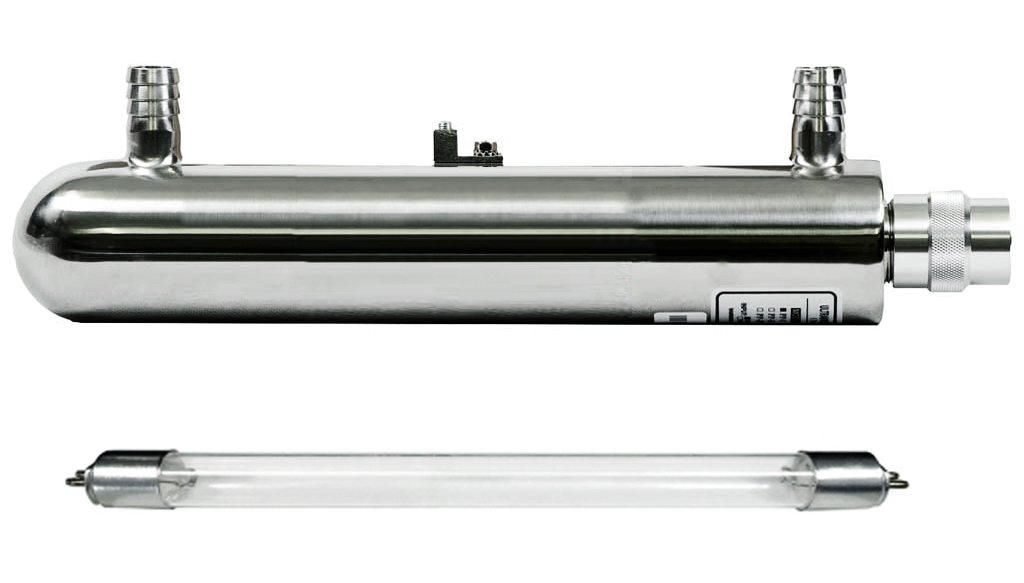
Image: UV light
3. UV disinfection
UV light can be used to kill microorganisms in water. The UV disinfection system includes an ultraviolet lamp that is installed in the pool's filtration system. As the water passes through the bulb, the UV radiation provides disinfection by destroying the cellular structure of the microorganisms, causing them to disintegrate. UV disinfection also effectively reduces the need to add chemicals.
Image: Solinator
4. Solinator
This is a device that allows disinfection of the water in the pool with the help of salt. It works on the principle of electrolysis, where the salt in the water is converted into chlorine gas, which then disinfects the water. The process of electrolysis separates the salt (sodium chloride) molecules into sodium and chloride ions, where the chloride ions combine to form chlorine gas.
The advantage of using a salinator is that it does not require the addition of chlorine or other chemicals to the pool, which makes maintenance easier and allows for a more natural and pleasant bathing experience. Each of these methods has its advantages and disadvantages, so it is important to choose the one that best suits your needs and the environment in which the hot tub is used. Regular maintenance of the disinfection system and water testing are also important to ensure safety and hygiene.
For the end
Warm water in a spa pool is a source of relaxation and pleasure, but it is important that it is clean and therefore safe to use. Water disinfection is a key part of maintaining pool water quality. Whether you use chlorine, bromine, ozone, UV disinfection or other methods, regular water testing and consistent maintenance of chemical balance is key to ensuring safe and hygienic water.
Also remember that professional advice is always available if you have any questions or concerns about the maintenance of your pool water. Call us at any time during the working day on +386 80 700 805.
Read more about maintaining a massage pool in our article.
If you are just thinking about buying a massage pool, you can see all the models here.
An apartment with a jacuzzi is now one of the most sought-after and attractive forms of tourist accommodation. Guests are increasingly looking for more comfort, privacy, and a sense of indulgence, while property owners are looking for ways to increas..
Sauna for Two as the Perfect Private Wellness Experience for Couples
A sauna for two is a private sauna for couples, designed for those who want to enjoy a relaxing wellness experience together without other guests or distractions. This type of saun..
Buying a hot tub is a wonderful decision that can improve your quality of life, reduce stress and increase your overall wellbeing. At the same time, it is an investment where mistakes often happen, especially for customers who are choosing a hot tu..
Saunas have been a popular way to relax, detox, and boost health for centuries. The best known are the Finnish sauna with dry heat and the infrared sauna, which warms the body with IR rays. Because people often wonder which sauna is right for the..
In our daily lives, we increasingly value solutions that save us time, ensure hygiene, and bring an extra touch of comfort. That is why a smart toilet or intelligent WC is no longer just a vision of the future – although still relatively new on the m..
In recent years, ice baths have experienced a true revival. What was once part of ancient healing practices and northern traditions is today one of the most popular methods for regenerating the body and mind. Athletes, businesspeople, and everyone se..
An infrared sauna (IR sauna) directly heats your body with infrared rays rather than heating the air inside the cabin.
Below, we explain how it works, its benefits,
infrared sauna disadvantages, and practical tips for choosing th..
Modern society faces challenges related to an aging population and changing lifestyles. More and more people are turning to a more sedentary lifestyle, leading to problems such as muscle stiffness, joint problems, and reduced mobility. There is a s..
Summer brings hot sunny days, refreshments with cold drinks, jumping into the sea or pool, and relaxed evenings on the terrace. Why would you want to use a sauna on hot summer days anyway? We often associate the sauna only with the cold season of ..
In a fast-paced world where daily responsibilities often merge into a continuous series of challenges, finding moments of true rest has become crucial. As a store that strives to provide the best solutions for the well-being of our customers, we hav..


-300x300.jpg)


-250x250.jpg "ASTARIJA MEGATRON - Professional massage chair")


-250x250.jpg "XSTO TR250T - Stair climber for wheelchair")
-250x250.jpg "XSTO M4 - Power mobility chair / Mobility robot")
-250x250.jpg "XSTO TR140C - Stair climbing wheelchair")










-435x300h.jpg "Apartment with a Jacuzzi as an Advantage for Guests and Property Owners")
-435x300h.png "Sauna for Two as a Perfect Wellness Experience for Couples")
-435x300h.png "The Most Common Mistakes When Buying a Hot Tub and How to Avoid Them")


-435x300h.png "Why use the sauna in summer?")

Leave a Comment